
CPE + Events Catalog
2026-27 OSCPA-Select™ CPE - 2 catalog options: 

1. Online Catalog - New Browsing Experience (see tabs below).

Browse CPE by Field of Study, and use the Format/Type filter to narrow by In-Person, Webcast, Bundles or On-Demand.

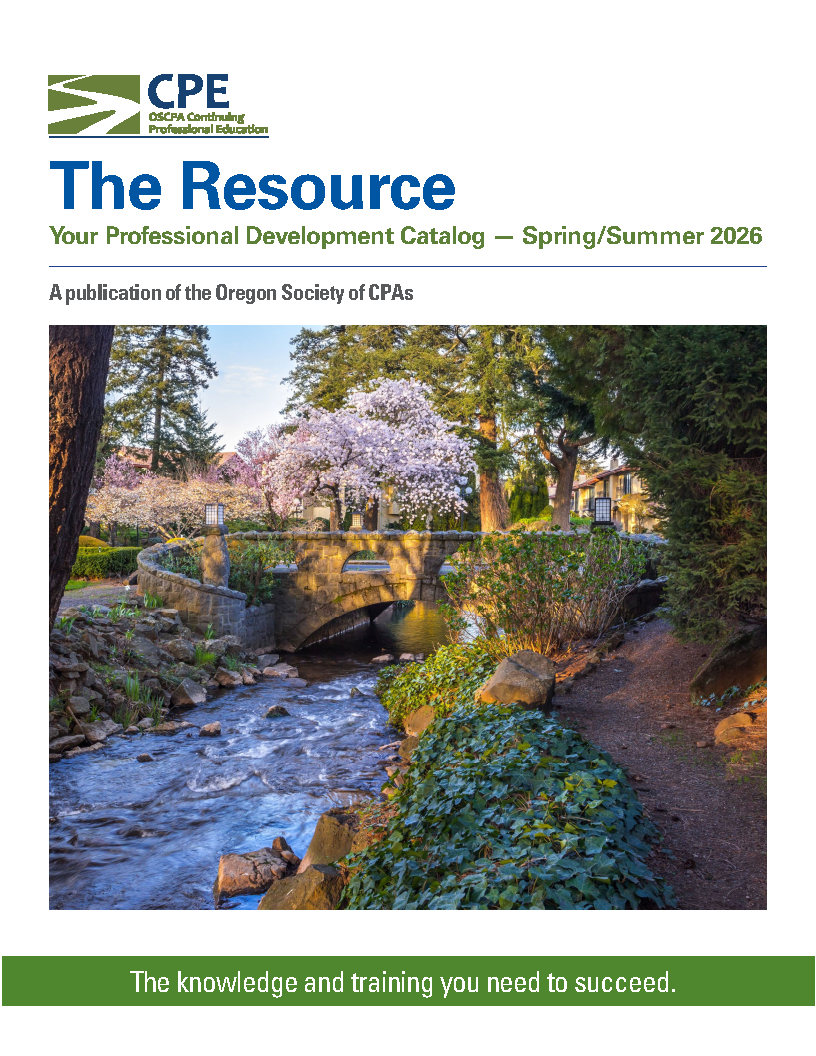
2. Download the Resource Catalog (pdf) - Click here (49 pages)

Showing 12101-12120 of 16344 Results (Page 606 of 818)

Entertainment, Meals & Travel Expenses: Review and Update (2 hours)

-

Online

2.0 Credits

Member Price: $89

See more dates

This program reviews the statutory and regulatory guidance as they relate to fringe benefits. There will be an emphasis on entertainment, meals and business transportation expenses, including qualified employer-provided parking, with a focus on planning opportunities. Recent federal tax legislation, cases and rulings will also be addressed. This event may be a rebroadcast of a live event and the instructor will be available to answer your questions during the event.

More Dates

Revenue Recognition - Topic 606 Overview (1.8 hours)

-

Online

1.8 Credits

Member Price: $79

See more dates

This session is the beginning in a series on the new revenue recognition standard. The standard outlines five steps for proper compliance. At the surface, these steps seem simplistic. However, there are many considerations that should be considered within each step based on your process and industry. This course is designed to provide an overview of the technical guidance and outline the five steps involved in the revenue recognition model. We also explore some concepts to consider within each step and then evaluate some challenges that specific industry's may have when complying with the standard. Future courses will further delve into each step and provide example and scenarios that should be considered to properly apply the step.

More Dates

Common Financial Statement Disclosures (2 hours)

-

Online

2.0 Credits

Member Price: $89

See more dates

Financial statement disclosures are important to provide the information necessary for financial statement users to make economic decisions. Disclosures further explain and clarify information provided in the basic financial statements, but also provide critical information about subsequent events, litigation risk, and other concerns. This course focuses on the most common financial statement disclosures for small- or medium-sized nonpublic entities. This event may be a rebroadcast of a live event and the instructor will be available to answer your questions during the event.

More Dates

How to Develop Your System of Quality Management Using the AICPA Practice Aids (3 hours)

-

Online

3.0 Credits

Member Price: $109

See more dates

This course provides an overview of the Quality Management standards and the requirements under SQMS 1. The AICPA requires CPA firms with accounting and auditing practices to implement a system of quality management, including firms performing preparation and compilation engagements. While the objective is to improve quality within the profession, implementation may seem overwhelming. To assist, the AICPA has developed practice aids to guide firms through the development and documentation process. In this webcast, Jeff walks through where to find the practice aids, how to use them, required documentation, use of the risk assessment template, and development of final documentation. Practical guidance is provided throughout to simplify implementation.

More Dates

Tax Implications of Retirement Plan Distributions (1 hour)

-

Online

1.0 Credits

Member Price: $55

See more dates

This session will address the complex rules of retirement distributions, review key provisions of the SECURE Act 2.0, and provide practical strategies of maximizing tax benefits for your client. This event may be a rebroadcast of a live event and the instructor will be available to answer your questions during the event.

More Dates

Internal Controls – Why They Are Important (2 hours)

-

Online

2.0 Credits

Member Price: $85

See more dates

The topic of internal control has long been an issue for business. Management may view internal control as a set of forms, checklists, and templates that auditors require. However, internal control is much more. Since the passage of the Sarbanes-Oxley Act (SOX), internal control (especially over financial reporting) has become a major focus for all organizations, regardless of their status as public, private, not-for-profit, sole proprietorship, partnership, or corporation. It is essential that managers understand and establish sound, effective, and proper internal controls for operations, compliance, and financial processes within the organization. Internal control can truly provide ultimate organizational value. Internal controls are defined as the mechanisms, rules, and procedures implemented by a company to ensure the integrity of financial and accounting information, promote accountability, and prevent fraud. Internal controls are a means by which an organization’s resources are directed, monitored, and measured. This includes operational and compliance activities. It plays an important role in preventing and detecting fraud and protecting the organization’s resources. Internal control is affected by an organization’s structure, work and authority flows, people, and information systems, and is designed to help the organization accomplish specific goals or objectives. For instance, a small organization with limited resources may not be able to segregate duties with the same rigor that a larger organization can. However, that does not give small organizations an excuse to ignore the importance of that control. They must find other ways to mitigate potential issues. In any event, internal control is part of an organization’s overall responsibility and requires due diligence to ensure its operations are effective. Management is the “keeper” and “inventor” of internal controls and must take ownership.

More Dates

Beyond the Basics: Financial Ratios You Might Be Overlooking (1 hour)

-

Online

1.0 Credits

Member Price: $55

See more dates

Overview: Understanding your company's financial health requires more than just traditional metrics. This webinar is designed to reveal deeper insights through advanced, underutilized financial ratios. In this session, accounting and finance professionals will explore metrics such as operating leverage, free cash flow yield, and margin of safety-tools that go beyond standard ratios to deliver nuanced perspectives on profitability, risk exposure, and operational efficiency. This event may be a rebroadcast of a live event and the instructor will be available to answer your questions during the event.

More Dates

Ethical Tax Practice Strategies in a Crisis World (2 hours)

-

Online

2.0 Credits

Member Price: $89

See more dates

This program addresses the many issues impacting CPA practice with a world in crisis. The unique challenges facing practitioners are related through actual practice situations - and then analyzed for their ethical implications. Based on real life experiences. This course does not qualify for IRS credit.

More Dates

Navigating IRS Authorizations: Form 2848 & Form 8821 (2 hours)

-

Online

2.0 Credits

Member Price: $89

See more dates

Providing a practical overview of the IRS Power of Attorney, Form 2848, and IRS Tax Information Authorization, Form 8821. Participants will explore the differences between these forms, understand when each is required, and how to comply with IRS requirements for representing clients and accessing their tax information. The course will cover practical issues, ethical considerations, and best practices for managing client authorizations through the IRS Centralized Authorization File (CAF) system. This event may be a rebroadcast of a live event and the instructor will be available to answer your questions during the event.

More Dates

Surgent's Annual FASB Update and Review (4 hours)

-

Online

4.0 Credits

Member Price: $159

See more dates

This course provides a detailed discussion on the key topics related to financial reporting, though in a summarized format. The course will focus on recent ASUs issued by the FASB, including the 12 ASUs issued in 2025, with a concentration on issues of greatest significance to most accounting practitioners. The greatest emphasis on the ASUs will focus on those effective in 2025 and 2026. Specifically, the course will review ASUs addressing financial instruments, disaggregated expenses, government grants, credit losses under ASC 326, and the final stages of the ASC 842 post-implementation review (PIR) report findings. Other hot-button accounting issues, such as what is on the FASB's technical agenda, are also discussed. This course is the place to go for a succinct but thorough update on the big topics impacting financial accounting and reporting.

More Dates

Forensic Accounting: Court Approved Methods of Proof (4 hours)

-

Online

4.0 Credits

Member Price: $149

See more dates

How does a forensic accountant calculate financial losses? Federal courts have approved various ways to calculate losses ranging from net worth method of proof to the expenditures method. Each method of proof depends on the available facts to the forensic accountant. This presentation will focus on the various court approved methods of proof, when to use them, and how to calculate the total loss. This event may be a rebroadcast of a live event and the instructor will be available to answer your questions during the event.

More Dates

Surgent's Fiduciary Income Tax Returns - Form 1041 Workshop with Filled-in Forms

-

Online

8.0 Credits

Member Price: $279

See more dates

This course is designed as a comprehensive guide to the core concepts of trust and estate income tax preparation. The course explains the common terminology and complicated income tax rules of estates and trusts, fiduciary accounting, and an introduction to or refresher on preparing Form 1041. This practical, over 300-page manual is an excellent reference source for your practice, which begins with quite simple cases. Building upon that base throughout the manual, the course ends with two complicated preparation cases, one trust and one estate, each with filled-in forms.

More Dates

Shortcuts that Excel Users Love (2 hours) [NT]

-

Online

2.0 Credits

Member Price: $89

See more dates

Many people that use Microsoft Excel know a great deal about the functionality of the application. There are, however, a tremendous number of hidden tools that a high percentage of users overlook. Additionally, there are newer features that some have not had the opportunity to explore. This session shows some of the numerous time-saving tools and features that often go unused by spreadsheet creators. People that wish to become more efficient when using Excel should take this session! This event may be a rebroadcast of a live event and the instructor will be available to answer your questions during the event.

More Dates

The Current and Future Landscape of Audit Technology (2 hours)

-

Online

2.0 Credits

Member Price: $89

See more dates

Explore the transformative impact of technology on the audit profession in this forward-looking course. Gain practical insights into cutting-edge tools and trends, including data analytics, artificial intelligence (AI), and automation, and discover how these advancements are revolutionizing audit methodologies and improving audit quality. Through engaging demos, case studies, and actionable tips, you'll learn how to navigate the evolving audit landscape with confidence and adaptability. This session is designed to equip CPAs with the knowledge to embrace innovation and stay ahead in a rapidly changing profession. This event may be a rebroadcast of a live event and the instructor will be available to answer your questions during the event.

More Dates

The Controller Function - Cash and Investments (1.4 hours)

-

Online

1.4 Credits

Member Price: $39

See more dates

This course corresponds to our Controllership series. This course is dedicated to exploring the traditional controller role and stepping out of the box to identify areas where the controller can continue to add strategic value to their organizations. Within this segment of our controllership series, we discuss the area of cash and investments and explore how the controller can move these responsibilities into more of a strategic role. In today’s world, the role of cash management is often a pivotal role in the organization. In economically difficult times, controllers may find that they spend a great deal of their time on understanding and managing the organizations' cash position. This is certainly important and, in some areas, can be seen as a staple of the lifeblood of the organization’s ongoing viability. This course takes a look at some of the typical objectives involved in cash management and then evaluates how those objectives can be further stretched into strategic pillars of the organization.  

More Dates

Develop Your Emotional Intelligence to Be More Successful in Life and Leadership (2 hours) [NT]

-

Online

2.0 Credits

Member Price: $89

See more dates

The difference between star performers and average ones in leadership roles is attributable largely to emotional intelligence (EQ). It’s surprising, then, that EQ is underrated as an essential ingredient for success in life and leadership. This presentation highlights the importance of EQ and provides participants with actionable tools to develop better relationships within and outside of the workplace, build healthy teams, and navigate constant change.

More Dates

An In-Depth Understanding of the Generation Skipping Transfer Tax (2 hours)

-

Online

2.0 Credits

Member Price: $89

See more dates

This course provides a focused and practical overview of the Generation Skipping Transfer (GST) Tax, designed specifically for professionals involved in estate and gift tax planning. As Part 4 of the Form 706 and 709 series, this session zeroes in on the rules, definitions, and application of GST tax, including the mechanics of calculating the inclusion ratio and how the GST exemption operates in real-world planning scenarios. Participants will gain clarity on how to identify skip persons, the types of transfers subject to the GST tax, and the proper treatment of direct skips, taxable terminations, and taxable distributions. Through clear examples and practical instruction, this course walks participants through voluntary, timely, late, and retroactive GST exemption allocations. With increasing regulatory complexity and heightened exemption limits, understanding the GST tax is critical for practitioners assisting clients in multigenerational wealth transfers. This course supports more accurate return preparation and strategic allocation of exemptions to minimize tax exposure. *Please Note:  If you need credit reported to the IRS for this IRS approved program, please download the IRS CE request form on the Course Materials Tab and submit to kori.herrera@acpen.com

More Dates

Compilation, Preparation and Review Basics and Peer Reviews (2 hours)

-

Online

2.0 Credits

Member Price: $89

See more dates

Cover the basic requirements for performing preparation, compilation, and review engagements under Statements on Standards for Accounting and Review Services (SSARS), including the new SSARS No. 25, Materiality in a Review of Financial Statements and Adverse Conclusions. Review common issues found on SSARS engagements in connection with peer reviews and the impact of various findings on the results of a peer review. Identify key issues to consider during SSARS engagements, and determine how to incorporate quality control recommendations and tips for performing high-quality SSARS engagements. This event may be a rebroadcast of a live event and the instructor will be available to answer your questions during the event

More Dates

Everyday Ethics at Work: Don't be the Next News Story! (2 hours) [NT]

-

Online

2.0 Credits

Member Price: $89

See more dates